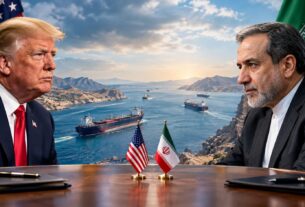
The Strait of Hormuz has not been formally closed.
Yet the latest shipping data reveals a far more troubling reality: commercial vessels are behaving as if the world’s most important energy corridor is still too dangerous to trust.
Commodity vessel traffic through the Strait of Hormuz has fallen to its lowest level in three months, with only a handful of tankers passing through the narrow waterway as tensions surrounding Iran continue to keep shipowners and energy markets on edge.
The decline matters because the Strait of Hormuz is not just another shipping route.
It is one of the world’s most critical energy lifelines.
Normally, vast volumes of crude oil, refined fuels and liquefied natural gas pass through the narrow passage between Iran and Oman. But the latest figures show that, despite efforts to restore safe navigation, many vessels are still choosing caution over transit.
And that may be the most important message from the data.
A waterway can be physically open while commercially remaining almost shut.
Traffic Falls to a Three-Month Low
According to preliminary shipping data from analytics firm Kpler, commodity vessel traffic through the Strait of Hormuz fell sharply on Monday.
The number of vessels using the route dropped to the lowest daily level since early May.
Both of the tankers recorded in the original report were entering the Gulf rather than carrying energy supplies out of it.
That distinction is significant.
The movement of ships into the Gulf does not automatically mean that oil and other commodities are flowing normally to international markets.
In fact, the broader pattern suggests that commercial traffic remains severely disrupted.
The latest figures came after weeks of uncertainty over attacks on vessels, military tensions and competing claims over how shipping should be managed through the strategically vital waterway.
The Real Crisis Is Confidence
The most striking aspect of the current situation is that the problem is no longer simply whether ships can physically pass through the Strait of Hormuz.
They can.
The bigger question is whether shipowners believe the journey is worth the risk.
A tanker operator must consider several dangers before entering the strait:
Could the vessel be attacked?
Could it encounter mines or unexploded hazards?
Will insurance costs make the journey financially impossible?
Could a new political or military escalation trap the ship inside the Gulf?
And who actually guarantees the vessel’s safety?
Until those questions have clearer answers, the number of ships passing through the waterway may remain far below normal levels.
This means that restoring shipping traffic requires more than reopening the route.
It requires rebuilding trust.
Iran and the US Are Sending Different Signals
The shipping slowdown is unfolding against a backdrop of continued tension between Washington and Tehran.
The United States has been increasing economic pressure on Iran while also seeking to prevent further disruption to navigation.
At the same time, Iran and Oman have discussed arrangements for managing traffic through the Strait of Hormuz, including the possibility of temporary navigation corridors and efforts to reduce maritime risks.
These developments suggest that diplomacy has begun to play a larger role.
But there is a major problem.
A temporary agreement or a proposed shipping corridor does not immediately convince commercial companies to send billion-dollar vessels through a conflict zone.
For shipowners, words are less important than evidence.
They want to see several weeks—or even months—of safe and uninterrupted transits before they can be certain that normal operations have truly returned.
Why Tankers Are Not Rushing Back
Shipping is a business built around risk.
When a region becomes dangerous, companies do not necessarily need a government to officially close a waterway.
They can simply decide not to use it.
That appears to be happening in the Strait of Hormuz.
The decline in traffic demonstrates how a strategic chokepoint can be disrupted without a formal blockade.
No large barrier is required.
No official closure notice is necessary.
A combination of attacks, threats, military activity and uncertainty can achieve the same result by convincing shipowners that the cost of using the route is too high.
This creates what could be called an “invisible blockade”.
The water remains open.
But the ships stay away.
The Impact Could Reach Far Beyond Oil
The Strait of Hormuz is closely associated with crude oil, but the disruption affects a much wider range of commodities.
The waterway is important for refined fuels, liquefied petroleum gas, chemicals and other industrial cargoes.
A prolonged slowdown could therefore create problems beyond the oil market.
Disruptions could affect manufacturing costs, transport prices and supplies of important industrial materials.
Energy-importing economies in Asia could be particularly exposed.
For countries such as India, China, Japan and South Korea, a prolonged disruption could increase import costs and create pressure on governments to find alternative supplies.
That is why the number of ships crossing Hormuz is being watched so closely.
The figure may look like a simple shipping statistic.
In reality, it is an early warning signal for the global economy.
Oil Markets Are Watching the Ships
Energy markets are especially sensitive to the flow of vessels through the Strait of Hormuz.
Even small signs that shipping is recovering can calm traders.
But a continued collapse in traffic can create fears about future supply shortages.
The current situation has therefore created an unusual divide.
On one side, diplomatic discussions and mine-clearing efforts have raised hopes that the crisis could ease.
On the other, shipping data shows that commercial activity has not yet returned to normal.
That gap between political optimism and commercial reality is crucial.
Governments may declare progress.
Markets, however, are waiting for the tankers.
The Strait Is Becoming a Test of Economic Security
The crisis in Hormuz now goes beyond a dispute over a single waterway.
It is becoming a test of whether the global energy system can continue functioning when one of its most important chokepoints becomes politically and militarily contested.
The longer shipping traffic remains low, the more companies will look for alternatives.
Oil producers may rely more heavily on pipelines that bypass the strait.
Importers may increase stockpiles.
Shipping companies may redesign their routes and contracts.
And countries may reconsider how dependent they want to remain on a waterway controlled by geopolitical tensions.
Iran may have long viewed the Strait of Hormuz as a strategic source of influence.
But the current crisis could also encourage the rest of the world to reduce its long-term dependence on it.
The Next Few Days Could Be Crucial
The biggest question is whether the recent drop in traffic represents a temporary pause or a more serious pattern.
If vessel numbers begin to rise steadily, the market may see it as evidence that confidence is returning.
But if the three-month low becomes the new normal, the consequences could be much more serious.
Oil prices could become more volatile.
Shipping costs could remain elevated.
Alternative routes and energy supplies could become increasingly important.
And governments may face growing pressure to intervene.
The Strait of Hormuz does not need to be officially closed to create a global crisis.
The latest data is proof of that.
The waterway may be open, but the ships are still voting with their engines.
And for now, many appear to be saying the same thing:
The risk is still too high.
The real test of whether the Strait of Hormuz has truly reopened will not come from a government announcement or a military statement.
It will come when commercial tankers begin returning in large numbers.
Until then, the world’s most important energy corridor remains open in theory—but dangerously restricted in practice.