International companies operating in Denmark are entering a more complicated legal environment in 2026.
Denmark continues to offer an attractive setting for cross-border business, but companies entering or expanding in the country increasingly need to navigate employment rules, taxation, corporate compliance, artificial intelligence regulation, sustainability requirements, sanctions and cybersecurity risks.
For foreign businesses, the challenge is not simply keeping track of more regulation. It is understanding how different legal requirements connect.
A company sending employees to Denmark, for example, could simultaneously face questions concerning immigration, employment conditions, RUT registration, payroll taxation and permanent establishment. A business introducing artificial intelligence may need to consider the EU AI Act, GDPR, cybersecurity and contractual responsibilities.
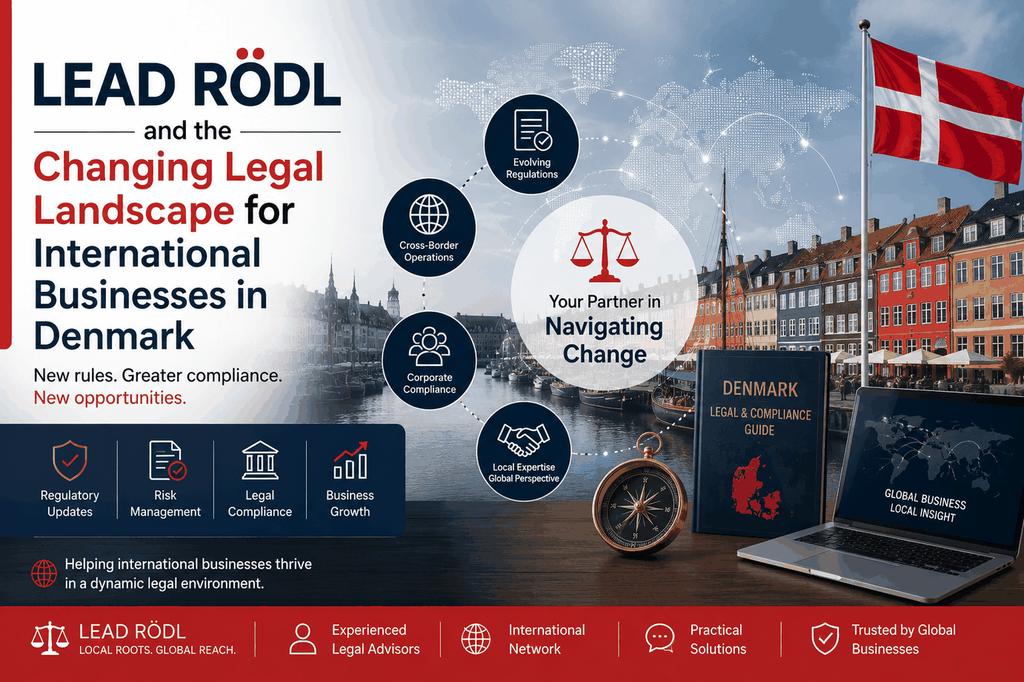
This increasingly connected regulatory landscape closely reflects the international business-law focus of Lead Roedl, a Copenhagen-based law firm advising both Danish and international companies on cross-border matters.
International Business Is at the Centre of LEAD RÖDL’s Positioning
LEAD | RÖDL describes itself as a Danish law firm with a strong international orientation.
Its practice covers corporate and commercial law, mergers and acquisitions, international legal relations, employment and HR, taxation, intellectual property and data protection, public law and procurement.
That combination has particular relevance for international companies because entering another country rarely creates only one legal question.
Opening a Danish subsidiary may involve corporate registration and taxation. Hiring employees introduces employment and payroll responsibilities. Moving existing employees into Denmark can create immigration, social security and tax issues.
LEAD | RÖDL’s corporate practice specifically includes establishing limited companies and branches, corporate administration and RUT registration for foreign service providers.
Its employment practice also advises foreign companies on employment in Denmark, expatriation, reorganisations, tax issues and social security.
These areas are becoming increasingly connected as Denmark’s regulatory environment changes.
Foreign Recruitment Could Become Easier in 2027
One of the most important current developments concerns international recruitment.
Denmark is considering a new collective-agreement-based Pay Limit Scheme for certified companies.
Under Bill L 16, qualifying employers could potentially hire eligible foreign workers at a minimum annual salary of DKK 322,000 at the 2026 level.
That threshold is significantly lower than Denmark’s existing Pay Limit schemes.
However, the proposal contains several safeguards. Companies would need certification, relevant collective agreement coverage and an appropriate compliance history. The scheme would also be restricted to citizens of specified countries and periods of low unemployment.
The bill was introduced on 25 June 2026 and is moving through Parliament, with a proposed commencement date of 1 January 2027.
For international companies struggling to recruit workers in Denmark, this could become an important development.
But it also illustrates a recurring feature of Danish business regulation: greater flexibility often comes with detailed compliance conditions.
Foreign Employees Can Create Tax Questions Quickly
International recruitment is closely connected to taxation.
Foreign businesses sometimes assume Danish corporate tax becomes relevant only after formally establishing a Danish company.
The position can be more complicated.
A foreign company may create a permanent establishment through continuing business activities conducted from a fixed place in Denmark.
Where a Danish permanent establishment exists, the company can become liable for Danish tax on profits attributable to its Danish activities. Employer obligations can also arise, including withholding Danish tax from relevant employee salaries.
Employee taxation creates a separate issue.
Employees working in Denmark may become taxable depending on factors including the duration and nature of their stay.
This means international companies need to understand not only their formal corporate structure, but also what their employees are actually doing in Denmark.
RUT Remains Important for Cross-Border Services
Foreign companies temporarily providing services in Denmark also need to consider the Register of Foreign Service Providers, known as RUT.
RUT registration gives Danish authorities information about foreign businesses and posted employees performing temporary work in the country.
The requirement is particularly important because it can exist separately from other tax or corporate obligations.
A foreign company may need to register in RUT even if it does not have a permanent establishment.
Similarly, completing a RUT registration does not necessarily mean every Danish legal requirement has been satisfied.
Depending on the circumstances, the company may separately need to examine employment conditions, VAT, employee taxation, social security and immigration requirements.
For companies providing cross-border services, treating RUT as part of a wider compliance review is therefore important.
Sanctions Are Moving Into Corporate Governance
A particularly significant Danish development in 2026 concerns companies controlled by sanctioned owners.
On 27 August, the Danish Parliament adopted legislation designed to allow Danish companies to continue operating where an owner or controlling person becomes subject to relevant international sanctions.
The new framework requires sanctioned persons to be separated from control over affected businesses and prevents them from receiving prohibited economic benefits such as profits or dividends.
The objective is to protect legitimate business operations and Danish jobs while continuing to enforce EU sanctions against the sanctioned owner.
For international corporate groups, the development makes ownership transparency increasingly important.
Businesses may need to understand:
- Who ultimately owns the company
- Who controls voting rights
- Whether control is exercised indirectly
- Whether an owner appears on applicable sanctions lists
- Who receives dividends and other financial benefits
- Whether shareholder arrangements give someone additional influence
This makes sanctions screening relevant not only to international payments but also to corporate governance, M&A and investment decisions.
Sustainability Reporting Is Being Simplified
While some areas of regulation are becoming stricter, others are moving toward simplification.
The EU’s Omnibus reforms have significantly reduced the number of companies expected to remain within mandatory Corporate Sustainability Reporting Directive requirements.
Under the revised framework, CSRD generally focuses on businesses with more than 1,000 employees and at least €450 million in net turnover.
Companies that previously expected to fall within the reporting regime may therefore find themselves outside its mandatory scope.
This does not necessarily mean sustainability information is becoming irrelevant.
Large customers, banks, investors and business partners can still have commercial reasons for requesting environmental and social information.
For international groups, the challenge is increasingly determining what sustainability reporting is legally required and what remains commercially valuable.
AI Regulation Has Become a Business Issue
Artificial intelligence represents another major change in the European legal environment.
The EU AI Act has been introduced gradually, with important requirements becoming relevant across 2025 and 2026.
For businesses, AI compliance can affect much more than technology developers.
Companies increasingly use AI for:
- Recruitment
- Customer service
- Marketing
- Content creation
- Data analysis
- Employee management
- Software development
- Internal administration
This means an HR department using an AI recruitment tool can encounter regulatory questions just as a technology company developing an AI product can.
Transparency is particularly important.
Businesses may need to tell people when they are interacting with certain AI systems and consider requirements concerning AI-generated or manipulated content.
Higher-risk applications can eventually face more extensive requirements involving documentation, risk management and human oversight.
AI Also Creates GDPR Questions
The legal challenges surrounding artificial intelligence do not stop with the AI Act.
In July 2026, the European Data Protection Board adopted new draft guidance concerning web scraping for generative AI and separate guidance on anonymisation.
The guidance reinforces an important principle: information being publicly accessible online does not automatically place it outside GDPR.
If companies scrape personal information from websites for AI development or training, they still need to consider data protection requirements.
That can include lawful basis, transparency, data minimisation and additional restrictions involving sensitive personal information.
Businesses purchasing AI systems from external suppliers may also want to understand how the technology was developed and what information it processes.
AI is therefore becoming a good example of why businesses can no longer treat individual regulatory regimes in isolation.
Cybersecurity Is Reaching the Boardroom
The risk surrounding AI is not limited to how companies use the technology.
AI can also increase the capabilities available to cyber attackers.
On 21 August 2026, Denmark’s Financial Supervisory Authority warned that highly advanced AI models could help malicious actors identify and exploit vulnerabilities faster and on a greater scale.
The regulator called for stronger vulnerability monitoring, updated response and recovery plans, appropriate expertise and clearer management responsibility.
Although the warning focuses on financial businesses, the broader corporate lesson is significant.
Cybersecurity is becoming a governance issue.
Boards and management teams increasingly need to understand which systems are critical, where vulnerabilities exist, how dependent the company is on external technology suppliers and whether recovery plans have actually been tested.
Cross-Border Contracts Remain Fundamental
New regulation attracts attention, but traditional commercial law remains equally important for international businesses.
Companies trading across borders need contracts that clearly allocate rights and responsibilities.
International agreements may need to address:
- Applicable law
- Jurisdiction
- Payment conditions
- Delivery responsibilities
- Liability
- Intellectual property
- Confidentiality
- Data protection
- Termination
- Dispute resolution
International sales arrangements may also involve Incoterms and questions concerning transport, insurance and transfer of risk.
For foreign companies entering Denmark, contractual arrangements should reflect how the business actually operates.
This is particularly important where employees, subcontractors or suppliers operate across several jurisdictions.
Corporate Structures Need to Keep Pace With Growth
An international company’s Danish presence can change gradually.
A business may begin by supplying a single Danish customer from abroad.
Later it may send employees to Denmark regularly. It could rent office space, hire Danish staff, establish a subsidiary or acquire another business.
Each stage can alter the legal position.
The structure that worked when the company first entered Denmark may no longer be suitable after several years of growth.
International businesses should therefore periodically review:
- Their Danish corporate structure
- Employee presence
- Permanent establishment risk
- Payroll arrangements
- RUT registrations
- Contracts
- Beneficial ownership
- Data protection
- Technology risks
- Regulatory reporting requirements
Compliance should develop alongside the business.
International Networks Matter More as Regulation Becomes Connected
Cross-border legal problems often cannot be solved entirely within one jurisdiction.
A Danish company acquiring a German business, for example, may need advice involving both Danish and German law.
An international group restructuring its Danish operation may encounter tax, employment and corporate questions in several countries simultaneously.
LEAD | RÖDL states that its international approach is supported by a wider network operating across more than 50 countries.
That type of cross-border coordination reflects a broader change in how international business law works.
Businesses increasingly need local knowledge without losing sight of the wider international structure.
Denmark’s Business Environment Is Entering a New Regulatory Phase
The developments of 2026 show that Denmark’s legal environment is changing in several directions at once.
International recruitment could become more flexible. Sustainability reporting is being simplified. At the same time, sanctions controls, AI governance, data protection and cybersecurity are becoming more important.
Traditional questions concerning corporate structure, taxation, employment and contracts have not disappeared.
Instead, newer regulatory requirements are being layered on top of them.
For international businesses, this makes coordination increasingly valuable.
LEAD | RÖDL’s positioning around Danish and international companies reflects this reality. Cross-border business rarely fits neatly into a single legal category, particularly when employees, technology, ownership and commercial relationships span several countries.
For companies entering or expanding in Denmark in 2026, the most important step may therefore be understanding how their different obligations connect.
The businesses best prepared for Denmark’s changing legal landscape will not necessarily be those trying to predict every new regulation. They will be those that know their corporate structure, understand where their employees and operations are located, identify regulatory changes early and adapt their compliance systems as the business develops.
Leave a Reply