
A rumor claiming Huawei founder Ren Zhengfei secretly left China with his family has raced across social media, arriving at exactly the moment Beijing introduced tougher rules governing international travel linked to national and technology security.
But there is an important problem with the story: there is no independent evidence confirming that Ren Zhengfei fled China.
The claim appears to have grown from a collection of unverified social-media posts, alleged screenshots and speculation about activity around Huawei’s headquarters in Shenzhen. Neither Huawei nor Chinese authorities has publicly confirmed that Ren left the country.
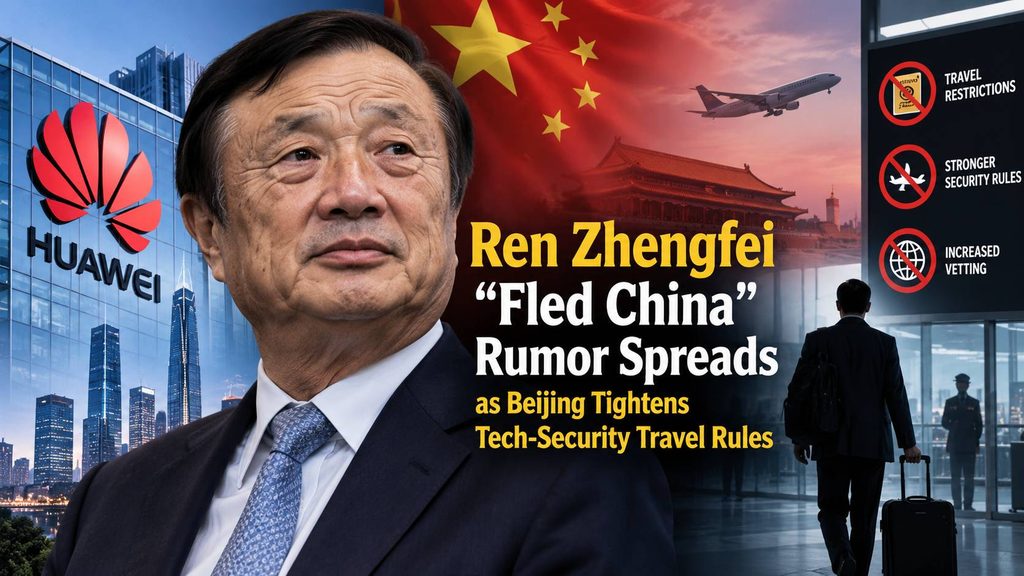
That makes this less a confirmed escape story and more a striking example of how quickly speculation can fill an information gap when politics, technology and national security collide.
How the Rumor Started
The speculation began circulating on Chinese social media around September 12, according to reports.
Posts claimed that Ren and members of his family had suddenly disappeared. Some versions of the story alleged that Ren, his wife and family members had traveled toward the coast near Shenzhen and eventually left China by sea.
Other posts referred to alleged internal Huawei messages and claimed there was an unusual police presence near the company’s headquarters.
None of those claims has been independently verified.
The alleged screenshots circulating online are not sufficient evidence by themselves to establish what happened to Ren, and reports about police activity have not been independently connected to his whereabouts.
Yet the timing gave the rumor an immediate sense of urgency.
Why September 15 Became the Key Date
China’s new entry-and-exit regulations came into effect on September 15.
The rules give authorities greater powers to restrict the departure of Chinese citizens in circumstances involving national security, industrial security and violations of technology import or export controls.
Reuters reported that exit restrictions can apply to people whose activities are considered to threaten national technology security. In certain circumstances, citizens returning to China after committing illegal or criminal acts abroad that harm national security or national interests can face exit bans ranging from six months to three years.
That immediately created the perfect environment for speculation.
The internet had a dramatic claim involving one of China’s most recognizable technology entrepreneurs. At almost exactly the same time, China was introducing rules specifically connected with technology and national security.
The two developments were quickly linked online.
But timing is not proof of causation.
No Confirmation That Ren Zhengfei Left China
Huawei Central’s original report explicitly noted that there was no evidence confirming the rumor and that neither Huawei nor senior Chinese officials had commented on it.
That remains the most important fact.
The claim that Ren escaped China should therefore not be presented as an established event.
Social-media posts may describe an alleged movement, but they do not establish that the movement occurred. Even claims involving supposed internal company communications or surveillance footage require independent verification before they can be treated as factual.
In this case, that verification has not emerged.
A New Development: Ren’s Daughter Appears in Beijing
There is, however, a notable development.
Huawei Central reported on September 16 that Annabel Yao, Ren Zhengfei’s youngest daughter, appeared publicly in Beijing on September 14 at a press conference connected with a Youku cultural program.
Yao also posted photos and videos from the event on Chinese social media.
Her appearance does not prove that Ren Zhengfei remained in China. But it does provide independently observable information about at least one member of the family and adds another complication to the dramatic online narrative.
Huawei Central itself cautioned that Yao’s appearance does not completely disprove the rumor about Ren.
In other words, one confirmed public appearance should not be turned into proof of an entire family’s movements.
What China’s New Rules Actually Change
The real news story may be less about Ren Zhengfei and more about what China’s new rules mean for people working in strategically sensitive industries.
Reuters reported that the regulations target circumstances involving export controls and technology import-and-export rules where violations could endanger China’s industrial or technological security.
China has already imposed tighter travel scrutiny on certain government officials and employees of state-linked companies with access to sensitive information.
The new framework broadens the importance of technology security in decisions concerning international travel.
That matters because China’s technology industry has become deeply connected to geopolitical competition.
Semiconductors, artificial intelligence, telecommunications equipment, rare-earth materials and other advanced technologies are increasingly treated as strategic assets by governments around the world.
A travel rule that explicitly connects technology-related violations with the ability to leave the country therefore has implications well beyond ordinary tourism or business travel.
Why Huawei Makes the Story Especially Sensitive
Ren Zhengfei is not an ordinary business executive.
He founded Huawei, one of China’s most strategically important technology companies, and the company has been at the center of years of geopolitical and technology disputes involving China and the United States.
Huawei has faced extensive U.S. restrictions, while Washington has repeatedly cited national-security concerns in its approach to the company.
That background helps explain why an unverified rumor involving Ren can spread so quickly.
When an ordinary business executive becomes unavailable for a few days, there may be little international interest.
When the founder of one of China’s most important technology companies supposedly disappears just before new national-security travel rules take effect, the story immediately attracts global attention.
But the same sensitivity also makes verification even more important.
The Information Gap Is Fueling Speculation
The episode illustrates a familiar problem in the age of social media.
When reliable information is limited, speculation can move faster than verification.
A screenshot can become a “report.” An unconfirmed sighting can become a disappearance. A new regulation can then be presented as the explanation for an event that has not actually been established.
Huawei Central quoted Taiwanese scholar and commentator JC Shen as saying the rumors were weak and could be fabricated, particularly given the limited public visibility of prominent Chinese figures and the lack of transparency surrounding China’s political leadership.
That does not prove the rumor is false.
It demonstrates why the claim should be treated cautiously.
What Would Actually Confirm the Story?
The question now is simple: what evidence would establish whether Ren Zhengfei actually left China?
A verified statement from Huawei would be significant.
Reliable reporting based on identifiable sources, official travel information or independently authenticated evidence could also help establish his whereabouts.
Until such evidence appears, claims about a secret nighttime departure, a sea escape or a family flight should remain categorized as allegations circulating online.
That distinction matters especially when the person involved is a major business figure and the subject is connected to national security.
The Bigger Story Is China’s Technology Security Push
Even if the rumor eventually disappears, the policy change behind it is real.
China’s new rules took effect on September 15, and Reuters confirmed that the regulations give authorities expanded powers to restrict travel in cases involving technology and national-security concerns.
That represents an important development in the relationship between technology and national security.
For years, governments have increasingly treated advanced technology as a strategic resource. China is now putting additional legal mechanisms around the movement of people connected with sensitive technologies.
The effect could extend to executives, engineers, researchers and other professionals whose work touches areas Beijing considers strategically important.
Rumor or Reality?
For now, the most accurate answer is straightforward: there is no verified evidence that Ren Zhengfei fled China.
The rumor surfaced just before China’s new technology-security travel rules took effect, which helped give the claim momentum. Social-media posts alleged that Ren and his family disappeared and left through the Shenzhen coast, but those claims have not been independently established.
At the same time, Ren’s daughter Annabel Yao was publicly seen in Beijing shortly before the new rules came into force, providing a confirmed piece of information amid a sea of speculation.
The more consequential development is therefore not a confirmed escape.
It is the fact that China’s technology-security rules are becoming more closely connected with international travel—and that this change is creating a new layer of uncertainty around some of the country’s most strategically important technology figures.
In a story moving at social-media speed, the most important detail may be the one that has not yet been proven.