
Saudi Arabia is reportedly exploring an unusual new channel for dealing with the growing Houthi threat: intelligence cooperation with Israel.
According to Israeli media reports cited by Hindustan Times, Riyadh and Israel have held discussions facilitated by the U.S. Central Command, with the focus reportedly on intelligence that could help Saudi Arabia identify Houthi military positions and anticipate possible attacks.
The reported contact does not mean Saudi Arabia and Israel have suddenly formed a military alliance. Nor does it establish that Israeli forces are directly participating in Saudi operations.
Instead, the development points to something potentially more significant: regional governments are increasingly willing to explore discreet security cooperation when attacks threaten critical infrastructure and shipping routes.
Why Saudi Arabia Is Looking for More Intelligence
Saudi Arabia has faced a growing series of missile and drone threats from Yemen’s Iran-aligned Houthi movement.
The attacks have increasingly focused on targets connected with Saudi infrastructure, including energy facilities and routes used to move oil toward the Red Sea.
That creates a problem for Riyadh that goes beyond air defense.
Knowing where an incoming missile or drone originated is useful. Knowing where the launchers, command centers and other military assets are located before an attack happens can be even more important.
That is where intelligence becomes valuable.
The reports indicate that Saudi Arabia is seeking information that could provide a clearer picture of Houthi positions and possible plans.
The U.S. Is Already Playing a Go-Between Role
The reported Saudi-Israeli discussions come only days after Riyadh sought direct U.S. assistance against the Houthis.
Reuters reported that Saudi Crown Prince Mohammed bin Salman asked President Donald Trump for help as Houthi threats increased around the Red Sea.
Washington did not agree to launch direct strikes against the Houthis at that stage. Instead, the United States told Riyadh it would provide intelligence-sharing and targeting assistance, according to sources cited by Reuters.
U.S. Central Command commander Admiral Brad Cooper also traveled to Saudi Arabia for discussions.
That provides important context for the reported Saudi-Israeli contact.
Rather than Riyadh and Jerusalem suddenly establishing an independent military partnership, the emerging picture is one in which U.S.-mediated security channels are connecting countries that share concerns about the Houthi threat.
Why Israel Has Valuable Houthi Intelligence
Israel has spent years monitoring Iran and Iranian-aligned armed groups across the Middle East.
The Houthis are particularly important because they have repeatedly demonstrated their ability to use missiles and drones over long distances and to threaten maritime traffic.
Israeli intelligence could potentially complement information gathered by Saudi Arabia and the United States.
Reports indicate that the discussions have focused primarily on identifying Houthi military locations and assessing what the group might do next.
But the precise nature and scale of any intelligence sharing remain unclear.
There has been no public announcement establishing a formal Saudi-Israeli intelligence agreement.
The Timing Is Crucial
The reported outreach comes as the security situation around Yemen’s Red Sea coast is deteriorating.
The Houthis have expanded their territorial position along parts of Yemen’s Red Sea coastline and are threatening one of the world’s most strategically important maritime corridors.
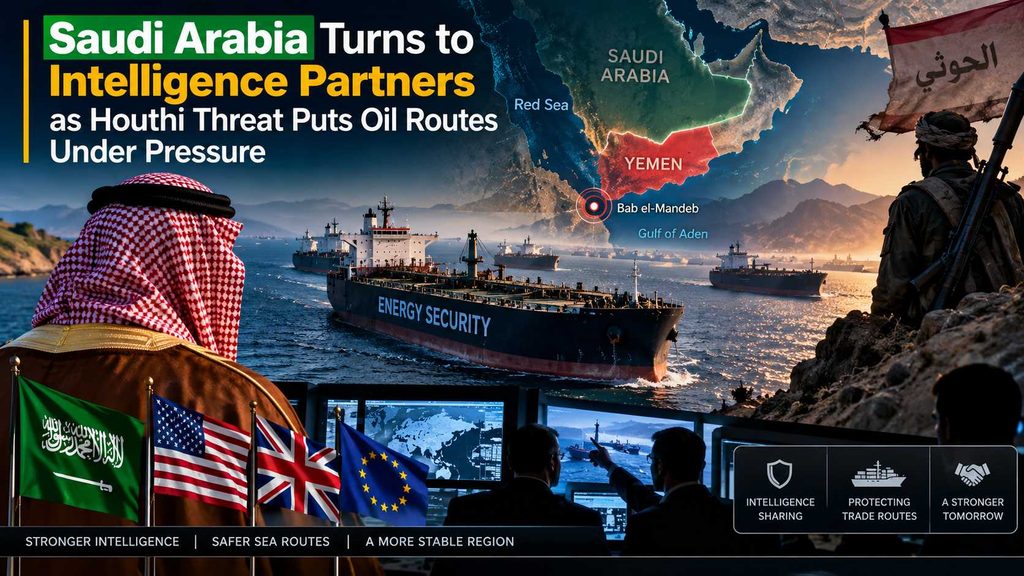
The Bab el-Mandeb Strait connects the Red Sea with the Gulf of Aden and provides a crucial route between Europe and Asia.
Its importance has increased further because the wider regional conflict has disrupted traffic through the Strait of Hormuz.
That has created a complicated situation for Saudi Arabia.
Oil that might otherwise move through the Gulf and Hormuz has increasingly relied on alternative routes, including Saudi infrastructure leading toward the Red Sea.
If Houthi attacks threaten those routes as well, Riyadh faces pressure from two directions.
Saudi Oil Infrastructure Is Part of the Equation
The latest Houthi attacks have reportedly affected Saudi oil infrastructure and contributed to the temporary suspension of parts of the kingdom’s East-West oil pipeline system.
That pipeline is strategically important because it allows Saudi crude to reach the Red Sea without traveling through the Strait of Hormuz.
Reuters and other reports have highlighted the importance of the route as Saudi Arabia seeks ways to keep oil exports moving amid wider regional disruption.
This explains why intelligence has become such an important part of the Saudi response.
The issue is no longer simply defending cities.
Saudi Arabia also needs to protect pipelines, pumping facilities, ports, shipping lanes and other infrastructure that keeps its energy exports connected to global markets.
A Different Kind of Saudi-Israeli Contact
Saudi Arabia and Israel do not have formal diplomatic relations.
That makes reports of intelligence discussions particularly notable.
However, the reported contact should not automatically be interpreted as evidence of a broader political rapprochement.
Security cooperation can occur quietly and on specific issues even when governments disagree on other major regional questions.
The reported Houthi discussions appear to fall into that category.
The immediate concern is a shared security problem rather than a public realignment of diplomatic relations.
Pakistan’s Position Adds Another Layer
The reported Saudi outreach also comes as Riyadh looks for wider regional support.
Saudi Arabia has sought assistance from other partners while confronting the Houthi threat. Pakistan has expressed solidarity with Saudi Arabia, but reports indicate that Islamabad has not committed troops to fight the Houthis.
That leaves Riyadh facing a difficult calculation.
It has capable military forces and sophisticated air-defense systems, but the geography of the conflict makes the problem difficult to solve through air defense alone.
The Houthis operate from Yemen’s rugged and contested territory, making accurate intelligence essential to identifying mobile military assets.
The Human Cost Is Growing Too
The military story is only one part of the crisis.
The renewed fighting in Yemen has already displaced more than 100,000 people internally, according to the United Nations refugee agency, while thousands more have fled by sea toward Djibouti.
As fighting expands, damage to infrastructure and restrictions on movement are making humanitarian assistance more difficult.
That means the security calculations in Riyadh, Washington and Jerusalem are unfolding alongside a worsening humanitarian situation inside Yemen.
Why This Matters Beyond Saudi Arabia
The biggest consequence of the Houthi conflict may not be limited to the Middle East.
The Bab el-Mandeb is a major international shipping corridor. Any prolonged disruption can affect the movement of energy and commercial goods between Asia, the Middle East and Europe.
Oil markets are particularly sensitive because Saudi Arabia remains one of the world’s largest oil exporters.
If both Hormuz and Red Sea routes remain under pressure, traders and governments have fewer reliable transportation options.
That can translate into higher shipping costs, longer journeys and greater uncertainty for energy markets.
The Emerging Security Network
The reported Saudi-Israeli intelligence discussions reveal how quickly the region’s security relationships are becoming more complicated.
Saudi Arabia is communicating with the United States.
The United States is working through CENTCOM with regional partners.
Israel is reportedly being brought into intelligence discussions involving the Houthi threat.
At the same time, Saudi Arabia is seeking political and security support from other countries.
None of this necessarily represents a permanent alliance structure.
It does show that traditional diplomatic boundaries can become more flexible when governments face an immediate threat to national security and critical infrastructure.
What Happens Next?
The key question is whether the reported intelligence cooperation develops into a sustained arrangement.
For now, publicly available information points to discussions and reported intelligence assistance rather than a formal Saudi-Israeli military partnership.
Saudi Arabia’s immediate priorities are clearer: protect its territory, safeguard oil infrastructure and keep alternative export routes functioning.
The Houthis, meanwhile, have demonstrated that relatively inexpensive drones and missiles can create problems for enormously valuable infrastructure.
That imbalance is what makes intelligence so important.
A government does not necessarily need to intercept every incoming weapon if it can improve its ability to identify threats before they are launched.
A Quiet Shift With Wider Consequences
The reported Saudi request for Israeli intelligence assistance is therefore significant not because it suddenly changes the diplomatic relationship between Riyadh and Jerusalem.
Its significance lies in what it says about the region’s rapidly changing security environment.
Saudi Arabia is confronting a threat that crosses borders, targets energy infrastructure and reaches into international shipping lanes.
That is forcing Riyadh to look beyond traditional military partnerships and explore every available source of intelligence.
For now, the reported cooperation remains limited and largely indirect.
But if the Houthi threat continues to grow, the need for information, surveillance and early warning could become just as important as missiles and air-defense systems.
In a region where alliances can remain complicated, intelligence may become the quiet bridge connecting countries that are not yet ready to stand together publicly.