
A new political alliance has brought Scotland, Wales and Northern Ireland together around one principle: decisions about their constitutional futures should ultimately be made by the people who live there.
In an unusual show of coordination, senior leaders from the Scottish National Party, Plaid Cymru and Sinn Féin gathered in Cardiff and signed a joint memorandum calling for greater recognition of the right to self-determination.
The agreement puts renewed attention on one of Britain’s most persistent political questions: how much power should remain in Westminster, and how much should belong to the nations that make up the United Kingdom?
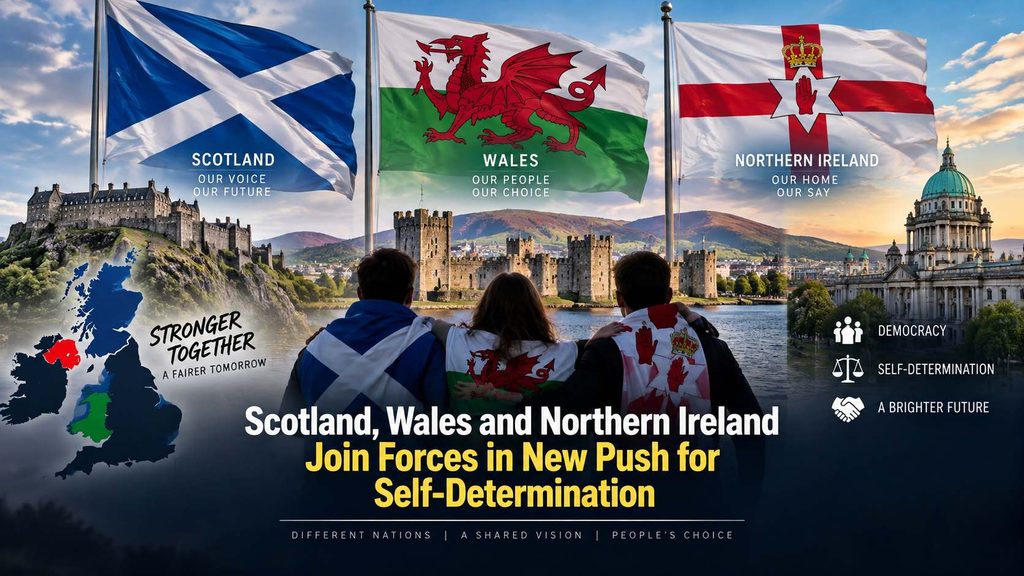
The leaders argued that Westminster should not be able to prevent democratic decisions about constitutional change.
A Rare Moment of Political Unity
The Cardiff meeting brought together Scottish First Minister and SNP leader John Swinney, Welsh First Minister and Plaid Cymru leader Rhun ap Iorwerth, and Northern Ireland First Minister and Sinn Féin vice president Michelle O’Neill.
Sinn Féin president Mary Lou McDonald also attended.
Although the participants hold government positions, they met and signed the agreement in their roles as political party leaders rather than as a joint meeting of the three devolved governments. That distinction is important because the constitutional powers of Scotland, Wales and Northern Ireland are not identical.
Still, the gathering represented an unusually coordinated message from political movements that all favour major constitutional change.
The Message to Westminster
At the centre of the agreement is the argument that people in Scotland, Wales and Northern Ireland should have the ability to determine their own political futures.
The document says no Westminster government should have the authority to block democracy or prevent people from deciding what constitutional arrangements they want.
For the nationalist parties, the issue goes beyond a single referendum.
It is about who should have the final say over questions of sovereignty, political authority and the future relationship between the nations and London.
Scotland Wants Another Independence Vote
Scotland is currently the most advanced of the three nations in terms of an independence referendum debate.
The country held its first independence referendum in 2014, when 55.3% voted to remain part of the United Kingdom.
The SNP has continued to campaign for another vote.
Swinney has argued that Scotland should have a democratic route to determine its constitutional future, while the UK government has maintained that the question cannot simply be decided by the Scottish government acting alone.
The legal framework remains important. In 2022, the UK Supreme Court ruled that the Scottish Parliament did not have the authority to hold an independence referendum without Westminster’s consent.
That legal question remains at the centre of the dispute.
Wales Takes a Different Approach
Wales has joined the broader self-determination campaign, but its position is more cautious on timing.
Plaid Cymru supports Welsh independence, and ap Iorwerth has said he wants Wales to have greater control over decisions affecting its future.
However, the party has ruled out holding an independence referendum during the current Senedd term, which runs until 2030.
Instead, the Welsh leadership has been pushing for greater devolved powers and a broader national discussion about Wales’s constitutional future.
That means the Cardiff agreement does not represent a common timetable for independence.
The three political movements share an underlying principle, but their routes toward constitutional change remain different.
Northern Ireland Has Its Own Constitutional Route
Northern Ireland’s situation is different again.
Under the Good Friday Agreement, the possibility of a future border poll is specifically recognised. Such a vote would concern whether Northern Ireland should remain part of the United Kingdom or become part of a united Ireland.
Sinn Féin has argued that preparations for such a choice should begin.
Recent comments by US President Donald Trump supporting the idea of Irish unity have also brought the issue into wider international attention.
But a border poll is not the same legal process as a Scottish independence referendum.
The constitutional arrangements and requirements are different, reflecting Northern Ireland’s particular history and the terms of the Good Friday Agreement.
One Alliance, Different Destinations
The Cardiff agreement is therefore notable precisely because the three parties do not have identical objectives.
The SNP seeks Scottish independence.
Plaid Cymru seeks Welsh independence but has not established an immediate referendum timetable.
Sinn Féin seeks Irish reunification.
What brings them together is the broader principle that constitutional decisions should be determined democratically by the populations concerned.
That makes the agreement more about shared political ground than a single unified independence campaign.
Cooperation Beyond Constitutional Politics
The parties are also looking at areas where cooperation could occur without immediately resolving the question of independence.
Energy, economic development, international engagement and relations with Europe are among the areas identified for closer cooperation.
The leaders have argued that working together could allow Scotland, Wales and Northern Ireland to pursue common interests while retaining their distinct political identities.
In that sense, the Cardiff meeting was not solely about breaking constitutional ties.
It was also an attempt to build a different kind of political relationship among the nations.
Westminster Pushes Back
The UK government has rejected the idea that the Cardiff agreement should determine Britain’s constitutional future.
The government has said Prime Minister Andy Burnham remains committed to the Union and wants to focus on issues such as economic security, jobs and household finances rather than further constitutional referendums.
The government has also stressed cooperation with the devolved administrations rather than constitutional separation.
That leaves the two sides with fundamentally different approaches.
The nationalist parties argue that the nations should have the democratic ability to determine their futures.
Westminster’s position is that the immediate priority should be governing within the existing United Kingdom.
Why the Cardiff Meeting Matters
The significance of the gathering does not lie in an immediate change to Britain’s constitutional structure.
No referendum was announced for all three nations, and the agreement itself does not create a legal mechanism for independence.
Its importance lies instead in the fact that political leaders from three parts of the UK have publicly coordinated around the principle of self-determination.
That creates a new political conversation about the relationship between Westminster and the devolved nations.
The UK Constitutional Question Enters a New Phase
Britain’s constitutional debate has been evolving for years.
Scotland’s 2014 independence referendum demonstrated how seriously the question could be contested. Brexit subsequently changed the UK’s relationship with the European Union and added another dimension to debates about sovereignty and political identity.
Now Scotland, Wales and Northern Ireland are presenting a more coordinated argument for greater control over their respective futures.
Whether that ultimately leads to new referendums, additional devolution or independence remains a matter for future political and legal developments.
For now, the Cardiff agreement has delivered a clear message from the nationalist parties: the constitutional future of Scotland, Wales and Northern Ireland should not be determined solely in Westminster.
How that principle translates into actual constitutional change, however, will depend on elections, public opinion, legislation and the legal frameworks governing each nation.