
The formal speeches and diplomatic meetings may have dominated headlines during the BRICS Summit 2026 in New Delhi, but some of the most eye-catching scenes emerged away from the conference table.
Newly released footage shows Prime Minister Narendra Modi interacting with Russian President Vladimir Putin, Chinese President Xi Jinping and other global leaders in more informal settings. The images include conversations over tea, handshakes, smiles, a ride in an elevator and interactions with senior international officials.
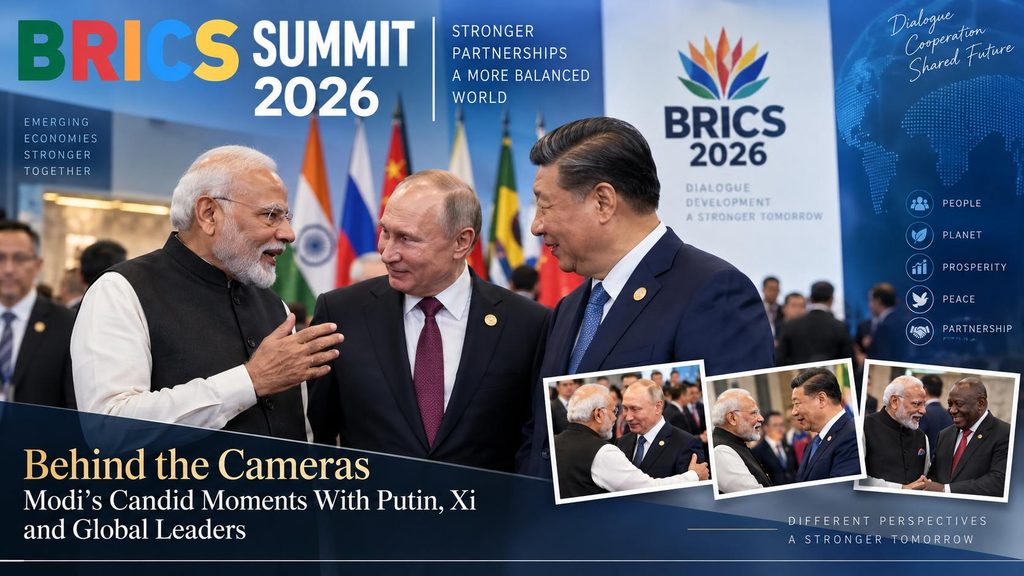
At first glance, these may look like simple summit photographs. But they offer another way of viewing a diplomatic gathering where countries with very different interests were sharing the same space.
The important point, however, is not to read too much into a smile or handshake. Informal images can show the atmosphere of an event, but they do not by themselves establish political agreements or major diplomatic breakthroughs.
When the Summit Moved Beyond the Conference Room
International diplomacy is usually presented through carefully arranged meetings, official statements and formal photographs.
The BRICS summit offered something different when cameras captured leaders during less structured moments.
One widely circulated clip shows Modi seated with Putin and Xi, apparently having tea and talking. Other footage shows Modi interacting with UN Secretary-General António Guterres and WHO Director-General Tedros Adhanom Ghebreyesus. Modi and Putin were also seen travelling together in an elevator, accompanied by their security teams.
These moments provide a glimpse of what happens between scheduled meetings.
They also make a major diplomatic event feel less distant. Instead of seeing leaders only behind podiums, viewers see them walking, talking and interacting in ordinary settings within an extraordinarily important political gathering.
Modi, Putin and Xi in the Same Frame
Perhaps the most striking images were those involving Modi, Putin and Xi.
The three leaders were photographed together during the summit, including images in which Modi appeared between the Russian and Chinese presidents. Other footage showed them interacting informally.
The pictures attracted attention because the relationships among these three countries are complex.
India maintains longstanding strategic ties with Russia while simultaneously managing difficult issues with China. Russia and China, meanwhile, have their own expanding strategic relationship.
That makes a relaxed public interaction visually striking.
But the photographs should be understood as evidence of engagement, not proof that all three countries have reached agreement on major geopolitical questions.
In diplomacy, the ability to sit together can itself be useful—even when countries continue to disagree on important issues.
The “Chai” Moment Became a Talking Point
The tea-table footage became one of the most shared visual moments from the summit.
Modi, Putin and Xi appeared together in a relaxed setting, creating an image very different from the formal scenes normally associated with international summits. The Economic Times also highlighted footage showing the three leaders sharing what appeared to be an informal “chai” conversation.
The scene quickly became symbolic because it placed three major Asian powers together in an ordinary social interaction.
Yet the real diplomatic significance lies less in the tea itself and more in the fact that leaders can maintain communication despite unresolved differences.
That distinction is important. A friendly photograph cannot tell us what was said privately, what disagreements remain or whether a specific policy has changed.
From Handshakes to Serious Diplomacy
The informal moments occurred alongside substantial diplomatic discussions.
During the summit, Modi held bilateral meetings with several leaders, including Putin, Xi and Iranian President Masoud Pezeshkian. He also met leaders and senior representatives from other BRICS members and partner countries.
These meetings covered a wide range of subjects, including bilateral relations, trade, defence, investment, technology, energy and regional developments.
The summit itself also produced the New Delhi Declaration, which addressed economic cooperation, technology, energy, food security, global governance and international security.
So the candid footage was only one layer of a much larger diplomatic event.
A Different Picture of India’s Diplomatic Balancing
The visuals also provide an interesting backdrop to India’s broader foreign-policy approach.
New Delhi has relationships with countries that do not always agree with one another. Russia remains an important partner, while India and China continue to manage longstanding differences. At the same time, India maintains extensive relations with the United States, Europe and other partners.
The BRICS summit placed several of these relationships in the same physical location.
The images of Modi interacting with Putin and Xi therefore attracted attention because they illustrated the breadth of India’s engagement.
Rather than treating one photograph as evidence of a particular geopolitical alignment, it is more accurate to see it as a snapshot of India’s effort to maintain dialogue across different relationships.
The World Leaders Were Not Just Posing
The candid footage was not limited to Modi.
Other participating leaders were also seen greeting one another, exchanging handshakes, smiling and interacting outside the most formal settings.
That matters because BRICS itself brings together countries with different priorities.
The group has expanded considerably from its original five-member structure, making the challenge of maintaining cooperation more complicated. The 2026 summit took place against the backdrop of conflicts and disagreements that have tested the ability of members to find common ground.
The informal scenes cannot resolve those differences.
But they show that the leaders were willing to remain in the same diplomatic space and continue communicating.
India’s Summit Venue Became a Diplomatic Stage
Bharat Mandapam in New Delhi became more than the location for formal BRICS sessions.
It served as a meeting point for leaders, diplomats, international organizations and business representatives.
Modi was seen showing visiting dignitaries elements of the summit venue, including cultural displays such as paintings and rangoli.
Such moments may appear secondary compared with geopolitical discussions, but they form part of how host countries present themselves during major international events.
India’s hosting of the summit combined formal multilateral diplomacy with bilateral meetings and cultural presentation.
Why These Images Captured So Much Attention
There is something naturally compelling about seeing powerful leaders outside their usual formal settings.
A podium tells us that a speech is taking place.
A conference table tells us that negotiations are underway.
But a photograph of three leaders sitting together over tea creates a sense of access to a different side of the event.
That does not necessarily make the moment more politically important.
It simply makes the diplomacy easier for the public to visualize.
The images humanize an event that can otherwise seem highly controlled and distant.
But Pictures Can Also Be Misleading
The popularity of the visuals comes with an important caveat.
A photograph can capture a smile but not the conversation that preceded it. It can show a handshake but not the disagreement that followed. It can show leaders sitting together without revealing whether they agreed on anything significant.
This is particularly important during a summit as politically complicated as BRICS 2026.
The visual record should therefore be read alongside official statements and verified reporting.
For example, Modi’s meeting with Xi included discussions about India-China relations, with the Indian government saying Modi emphasized the need for both countries to remain sensitive to each other’s core concerns.
That provides considerably more context than a photograph alone.
The Formal Summit Behind the Informal Moments
While the candid images dominated social-media attention, the summit produced a much broader diplomatic record.
BRICS members adopted the New Delhi Declaration, addressing cooperation in trade, finance, technology, energy and food security. The group also discussed global governance and international conflicts.
The summit therefore had two very different faces.
One was highly formal: declarations, speeches, negotiations and bilateral meetings.
The other was human and informal: tea, smiles, handshakes, conversations and shared moments.
Both are part of the same event.
A Glimpse Into Diplomacy, Not a Diplomatic Verdict
The rare footage from BRICS 2026 is compelling precisely because it shows something audiences rarely see.
Modi sitting with Putin and Xi, leaders exchanging greetings, and officials interacting outside formal sessions all provide a sense of the atmosphere inside a major international summit.
But the most useful way to interpret the images is with some restraint.
They show that leaders were engaging with one another.
They do not, by themselves, show that geopolitical differences have disappeared.
That distinction makes the footage even more interesting.
The real story is not simply that Modi shared informal moments with some of the world’s most powerful leaders. It is that these moments took place inside a summit where countries with competing interests were attempting to find areas of cooperation.
The Bigger Picture From New Delhi
The BRICS Summit 2026 demonstrated how modern diplomacy operates on several levels at once.
There are the speeches that make headlines, the declarations that record formal commitments, the bilateral meetings where sensitive issues are discussed—and then there are the brief human interactions that happen between them.
The newly released visuals capture that final layer.
They show Modi and other leaders not only as political representatives but also as participants in a long series of conversations, greetings and informal encounters.
The images may last only a few seconds, but they provide a different window into a summit shaped by much larger questions about global cooperation, economic change and geopolitical tensions.
Ultimately, the most revealing part of these “unseen moments” may be what they show without claiming to prove: in a divided international environment, diplomacy still begins with leaders being willing to sit down, talk and keep the conversation going.