
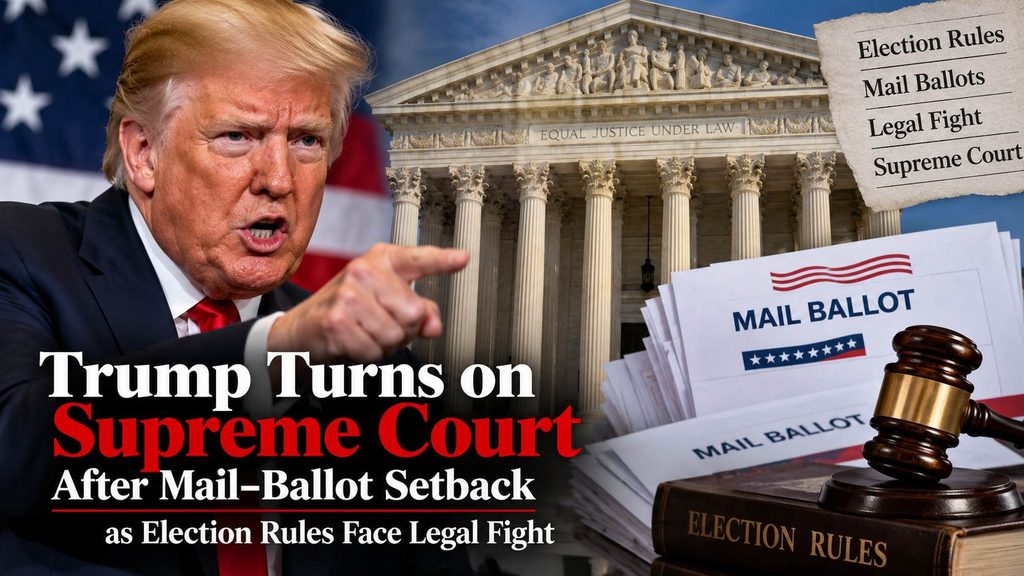
President Donald Trump has sharply criticized the U.S. Supreme Court after the justices declined to let his administration implement new restrictions on mail-in ballots ahead of the 2026 midterm elections.
Trump’s reaction was particularly notable because some of the justices he criticized were nominated by him during his first term in office. In comments posted after Monday’s decision, Trump questioned the judges’ decisions and complained that they had not acted as he expected.
The dispute, however, is about more than Trump’s confrontation with the judiciary.
At its core is a much larger question: How much power should the federal government have to change the way states administer elections, particularly when voting is already approaching?
Supreme Court Keeps Mail-Ballot Restrictions on Hold
The Supreme Court’s Monday order left in place a lower-court injunction preventing the U.S. Postal Service from implementing key parts of Trump’s mail-ballot plan for the upcoming November elections.
The justices said the administration was unlikely to succeed in its challenge to the lower-court order and that the circumstances did not justify emergency relief.
That means states can continue using their existing procedures for sending and handling mail ballots during the 2026 midterms.
The ruling did not settle every underlying legal issue. Instead, it determined whether the administration could put the disputed changes into effect while the broader case continued.
That distinction is important because headlines describing the decision as a final determination on all aspects of Trump’s election order would go further than the Court’s actual action.
What Did Trump Want to Change?
The controversy stems from an executive order Trump signed in March seeking changes to the federal handling of election mail.
Among the proposed measures were requirements involving ballot-envelope designs, barcodes and information about voters eligible to receive mail ballots. Under the USPS rule, states would have had to meet new requirements before the Postal Service would handle certain election mail.
The administration argued that the measures were intended to strengthen election security.
Opponents challenged the plan in court, arguing that the federal government was attempting to interfere with responsibilities traditionally handled by states and local election officials.
They also raised a practical concern: implementing major changes only weeks before a national election could create confusion and potentially prevent valid ballots from being processed correctly.
Why Timing Became Central to the Case
The timing of the proposed changes became one of the most important issues in the legal battle.
Mail ballots were already being prepared or distributed in some states when the dispute reached the Supreme Court. Election officials argued that changing procedures at this stage would create logistical problems.
Justice Brett Kavanaugh agreed with the Supreme Court’s decision to leave the lower-court injunction in place, although his separate opinion indicated that he viewed some of the administration’s legal arguments differently. His concern included the practical consequences of implementing the changes so close to the election.
Two justices, Samuel Alito and Clarence Thomas, dissented.
The result was therefore not a simple political division inside the Court. The justices differed over both the legal authority involved and the consequences of changing election procedures at this stage.
Trump’s Anger Turns the Spotlight on His Own Appointees
Trump’s reaction added another dimension to the story.
He specifically expressed frustration with Supreme Court justices whom he had nominated, arguing that their decisions did not reflect what he expected when they were selected.
Reuters reported that Trump criticized the justices after the mail-ballot decision and praised Alito and Thomas, who dissented.
The episode highlights an important feature of the U.S. judicial system: Supreme Court justices are appointed by presidents but do not formally serve as representatives of the presidents who nominate them.
Once confirmed, they serve on the Court independently.
That does not prevent presidents from criticizing their decisions, but it does mean that a president’s expectations and a justice’s later rulings can diverge sharply.
The Court Has Not Always Ruled Against Trump
The latest dispute also needs some context.
The Supreme Court has issued decisions benefiting the Trump administration on other issues, including some emergency applications. In August, for example, the justices allowed portions of Trump’s broader mail-voting executive order to move forward while litigation continued.
The September decision therefore represents a change in the immediate legal outcome, rather than evidence that the Court has adopted a single position on Trump’s election policies.
The broader legal fight is still developing.
States Remain at the Center of Election Administration
One of the central arguments from the states challenging Trump’s plan is that election administration is primarily conducted by state and local authorities, subject to federal constitutional and statutory requirements.
The administration has argued that the Postal Service has its own authority to regulate the mail and that states cannot demand unrestricted use of the federal postal system while exempting election mail from USPS rules.
That disagreement is now part of a broader legal debate about where federal authority ends and state election authority begins.
The Supreme Court’s latest action leaves the existing procedures in place for the 2026 midterms, but it does not necessarily end the underlying dispute.
Why Mail Voting Has Become Such a Political Flashpoint
Mail-in voting has been a major point of political disagreement in the United States for years.
Trump has repeatedly criticized mail voting and linked it to concerns about election security. Critics of those claims have pointed to the lack of evidence supporting broad allegations of fraud associated with mail ballots.
At the same time, millions of Americans use mail ballots, making changes to the system potentially significant for voters and election administrators.
The disagreement is therefore not simply about envelopes or postal procedures.
It concerns how elections are conducted and who has the authority to set those rules.
Election Officials Face the Practical Question
While lawyers debate constitutional authority in courtrooms, election administrators face a much more immediate problem: voters need clear instructions.
Election offices prepare ballots months in advance, coordinate mailing schedules and establish procedures for receiving and processing returned ballots.
Introducing new federal requirements close to an election can require changes to software, printing, ballot design, voter databases and staff procedures.
That practical dimension played an important role in the legal challenge.
The Supreme Court’s decision means election offices can continue operating under their established mail-ballot procedures for the coming midterms rather than suddenly adopting the disputed federal requirements.
What Happens Next?
The Supreme Court’s latest order does not necessarily end the litigation.
The broader legal questions surrounding Trump’s executive order and federal authority over election-related mail remain before lower courts, and additional challenges could eventually return to the Supreme Court.
For now, however, the immediate effect is relatively clear: the disputed USPS restrictions will not be implemented for the 2026 midterm elections under the Supreme Court’s latest decision.
That gives state and local election officials continuity as voting approaches.
A Bigger Test of the Separation of Powers
The dispute has become another example of the tension that can arise when a president seeks to make sweeping changes through executive action and courts are asked to determine whether those changes can legally take effect.
Trump’s criticism of the Supreme Court adds a personal and political dimension, particularly because some of the justices involved were his own nominees.
But the underlying institutional question is broader than one president or one election.
It is about the boundaries between the executive branch, Congress, the federal courts and state election authorities.
The Real Story Behind Trump’s “Not People I Interviewed” Remark
Trump’s comment about the justices he had “interviewed” has drawn attention because it reveals his frustration with a Court whose membership he helped shape.
Yet the legal story is more complicated than a president simply losing a case.
The Supreme Court has left the existing mail-ballot system in place for the 2026 midterms while the wider legal battle continues. The justices themselves did not speak with one unified voice, and at least one member of the majority indicated that questions surrounding the administration’s authority could be different outside the immediate election timetable.
For voters, the immediate consequence is straightforward: the mail-ballot procedures already in place remain in effect for the upcoming midterms.
For Washington, the larger question remains unresolved.
How far can a president go in changing election-related procedures through federal agencies—and where do the courts draw the line?
That question is likely to remain part of the American election debate well beyond November 2026.