India is moving aggressively to expand its network of free trade agreements at a time when the global trading system is undergoing one of its biggest shifts in decades. New trade partnerships can give Indian exporters better access to overseas markets, but the World Trade Organization is warning that the world may be moving toward a trading system where too many separate deals create new barriers instead of removing them.
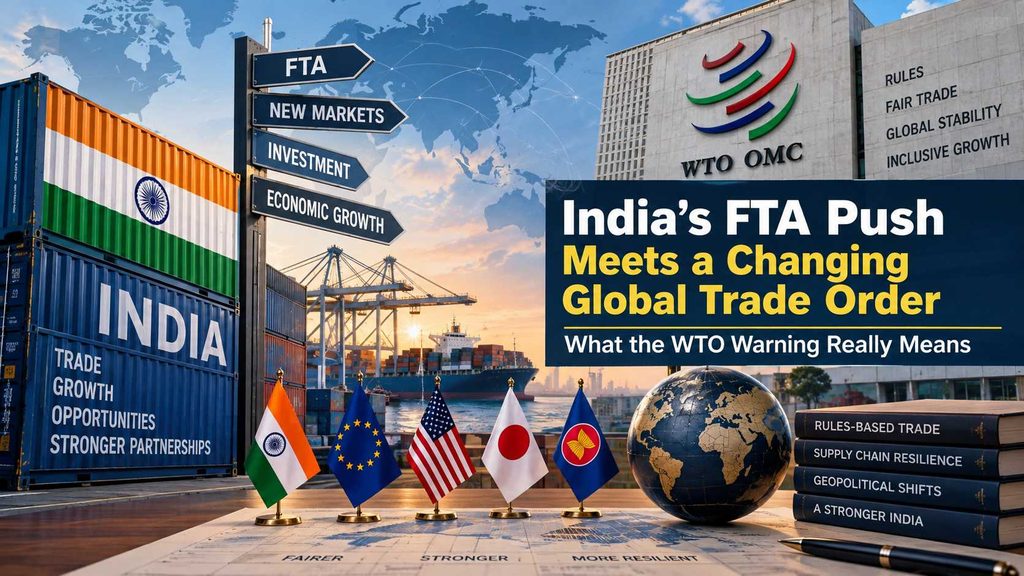
That tension is at the heart of the WTO’s World Trade Report 2026, released on September 15. The report presents a striking picture of what could happen if global commerce increasingly divides along geopolitical or preferential trade lines. In one scenario, a world split into geopolitical trading blocs could reduce global GDP by 5.1% by 2050. In another scenario, where the WTO system is replaced by a network of FTAs, the decline could reach 6.9%, with global exports falling by 26.9%.
For India, however, the message is more complicated than “stop signing FTAs.”
India Is Building Trade Links While the Rules Are Changing
India has been placing greater emphasis on trade agreements as exporters face a more competitive and uncertain global environment. The country is pursuing or implementing agreements with several major markets, including the European Union, the United Kingdom, New Zealand and other partners, while discussions with the United States remain important.
This strategy is designed to give Indian businesses preferential access to foreign markets and reduce tariff disadvantages compared with competitors.
The approach has become particularly relevant as governments around the world increasingly use tariffs, subsidies, industrial policies and other measures to protect domestic industries.
India therefore faces a practical question: if other countries are securing preferential access through trade agreements, can Indian exporters afford to remain outside those networks?
At the same time, the WTO report raises a broader question: what happens if every country reaches the same conclusion?
The WTO’s Concern Is About Fragmentation, Not FTAs Alone
The headline can make the WTO warning sound like a direct criticism of India’s FTA strategy. The report is more nuanced.
The WTO recognizes that regional and bilateral agreements can allow countries to cooperate more deeply in areas where multilateral negotiations move slowly. There are now more than 380 regional trade agreements notified to the WTO.
The problem emerges when these agreements begin replacing rather than complementing the broader multilateral system.
Imagine global trade as a large highway system. FTAs can create faster lanes between particular countries. That can be useful. But if every country builds separate lanes with different rules, tolls and entry requirements, the overall road network can become harder to navigate.
That is the fragmentation risk the WTO is highlighting.
A Divided Trade World Could Become More Expensive
The WTO’s modelling provides a warning about the potential economic cost.
In its “geo-fragmented world” scenario, global GDP could be 5.1% lower and exports 18.6% lower by 2050. Under the more severe “FTA world” scenario, global GDP could fall 6.9% and exports 26.9% compared with a stronger multilateral cooperation scenario.
These are modelling scenarios, not forecasts of what will necessarily happen.
They illustrate the possible cost of replacing common rules with increasingly separate trade arrangements.
The WTO also models an alternative in which multilateral cooperation is strengthened. In that scenario, global GDP could be 2.9% higher and exports 17.9% higher by 2050.
The message is therefore less about choosing between “FTAs” and “no FTAs” and more about ensuring that preferential agreements remain compatible with a functioning global trading framework.
India Has More at Stake Than Tariffs
For India, the FTA story is not simply about lowering customs duties.
Indian exporters are increasingly competing on supply-chain reliability, manufacturing capacity, standards, technology, logistics and speed of delivery.
Commerce Minister Piyush Goyal recently said that once competitive tariff rates are secured in the proposed India-US trade arrangement, exporters would increasingly have to compete on scale, quality and timely delivery rather than relying on tariff differences. He has also stressed the need for genuine domestic value addition and stronger use of existing trade agreements.
That point is important because an FTA can open a door, but it does not automatically create exports.
Indian companies still have to walk through it.
A lower tariff may help a manufacturer compete in Europe or another major market, but the company also needs sufficient production capacity, internationally accepted standards, competitive pricing and dependable logistics.
India’s Diversification Strategy Has a Logic
There is another side to the WTO warning.
As global trade becomes more uncertain, having multiple commercial relationships can give countries greater flexibility.
For India, expanding trade links with Europe, the UK, New Zealand and other economies can reduce dependence on any single market. It can also create opportunities for Indian businesses in sectors ranging from engineering and pharmaceuticals to textiles, services and manufactured goods.
The WTO itself acknowledges that the distribution of economic power has changed dramatically. Low- and middle-income economies accounted for about 45% of global merchandise trade in 2024, compared with 23% in 1995.
That transformation creates new opportunities for developing economies to negotiate market access.
India is one of the countries trying to make use of that changing economic landscape.
The Real Challenge Is Making FTAs Work
Signing an agreement is only the beginning.
India has previously faced criticism over relatively low utilization of some trade agreements, with businesses not always taking full advantage of preferential market access.
That makes implementation increasingly important.
Companies need to understand rules of origin, documentation requirements, product standards and tariff preferences. Government agencies also need to help smaller businesses understand how to use these agreements.
This is particularly important for smaller exporters. A large corporation may have teams dedicated to international trade compliance. A small manufacturer may not.
If India wants FTAs to translate into larger exports, market access has to reach businesses beyond the biggest corporate exporters.
The WTO Still Matters More Than the Headlines Suggest
Despite the rise of bilateral agreements, the multilateral system has not disappeared.
The WTO says approximately 72% of global merchandise trade still takes place under most-favoured-nation terms, meaning the basic WTO framework remains the foundation for a large share of international commerce.
That is an important detail often lost in discussions about trade fragmentation.
The world has not moved completely from one system to another. Instead, multiple systems are operating alongside each other.
The challenge is keeping those systems compatible.
AI Could Change the Trade Debate Again
The WTO report also points to another force that could reshape international commerce: artificial intelligence.
According to WTO simulations, AI could increase global trade by around 40% by 2040, with particularly significant effects on digitally delivered services. The technology could also add more than 13% to global GDP over the next 15 years under the report’s modelling assumptions.
For India, this could be particularly significant because the country has a large services and technology sector.
It also suggests that future trade negotiations will involve much more than tariffs on physical products. Data, digital services, technology standards, intellectual property and AI-related rules are likely to become increasingly important.
India’s Trade Strategy Is Entering a More Complicated Phase
The WTO’s warning comes at an important moment for India.
The country needs greater access to international markets, stronger export growth and more diversified supply chains. FTAs can contribute to those goals.
But the global environment is becoming more complicated at the same time.
More tariffs, industrial subsidies, geopolitical tensions and competing trade blocs could make international commerce less predictable. The WTO says that allowing the multilateral system to weaken could impose significant economic costs, particularly on smaller and poorer economies.
That means India’s challenge is not simply to sign more agreements.
It is to build agreements that expand market access while keeping Indian businesses connected to as many parts of the global economy as possible.
The Bigger Question for India
India’s FTA push and the WTO’s fragmentation warning may initially appear contradictory. In reality, they reflect the same problem from two different angles.
India is responding to a world in which trade rules are becoming more fragmented. The WTO is warning that allowing that fragmentation to become the permanent structure of global commerce could make everyone worse off.
For India, the practical task is therefore a balancing act: pursue market access where it creates opportunities, diversify trading relationships, improve domestic competitiveness and continue supporting a rules-based global system.
The future of trade may not be decided by one major agreement or one organization. It could instead be shaped by thousands of decisions made by governments and businesses about where they buy, where they invest and where they sell.
India is trying to make sure it has a place in as many of those markets as possible. The WTO’s warning is that the world must also make sure those markets remain connected.