
The financial cost of the US war with Iran is now coming into sharper focus, but a new Pentagon watchdog report points to another problem that could prove just as important: the United States has used weapons faster than its defense industry can comfortably replace some of them.
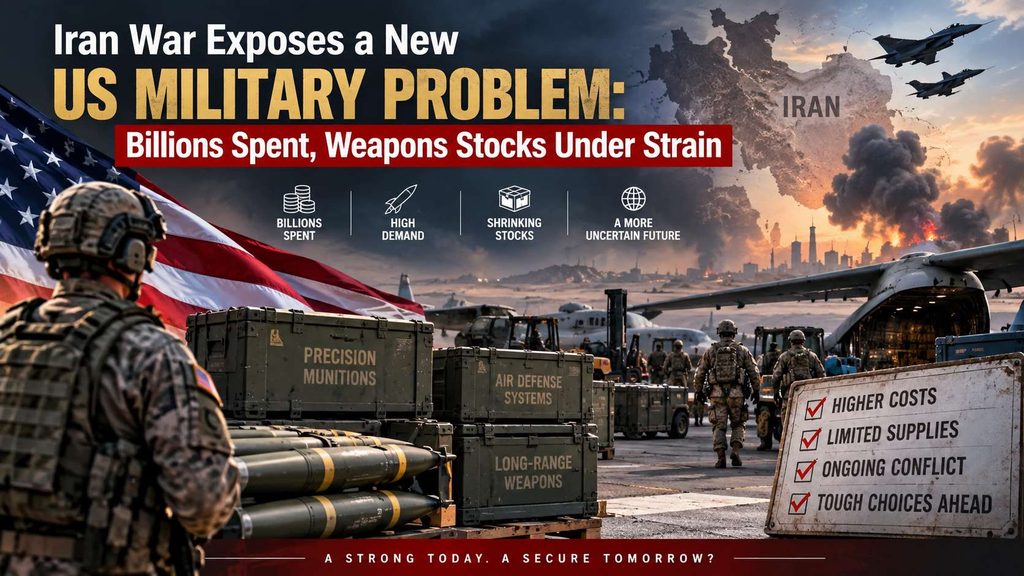
A Defense Department inspector general report says the United States spent an estimated $33.4 billion on the conflict through June 30, including $22.3 billion worth of munitions. The report says the heavy expenditure created strategic inventory shortfalls and exposed bottlenecks in the US defense-industrial base.
That changes the way the cost of the conflict can be viewed.
The headline number is enormous. But the more consequential issue may be what happens after the missiles have been fired, the interceptors have been used and damaged equipment has to be replaced.
The $33.4 Billion War Bill
According to the Pentagon watchdog, the estimated $33.4 billion cost through June 30 included three major categories.
About $22.3 billion went toward expended munitions, while approximately $3.7 billion was attributed to equipment losses and another $7.4 billion to other expenditures. The estimate does not include the future cost of repairing all damaged facilities.
The figures cover the early months of Operation Epic Fury, which began on February 28.
The spending illustrates how quickly modern warfare can consume extremely expensive weapons.
A missile fired today does not simply represent the price of the missile. It also represents manufacturing capacity that may take months or years to replace, depending on the weapon.
That is where the Pentagon’s latest warning becomes significant.
The Bigger Problem Is Not Just Money
A country can theoretically spend more money to replenish its arsenal.
But money alone cannot instantly create factories, specialized components, trained workers and production lines.
The Pentagon inspector general said the expenditure of munitions during the Iran conflict resulted in strategic inventory shortfalls and revealed bottlenecks in the industrial base responsible for resupplying weapons.
In other words, the war has exposed a gap between how quickly the US military can consume certain weapons and how quickly American industry can manufacture replacements.
That is a very different problem from simply having a large defense budget.
Air Defense Has Become Especially Important
One of the most closely watched areas is the US inventory of advanced air-defense interceptors.
Weapons such as Patriot and THAAD interceptors are designed to destroy incoming ballistic missiles and other threats. They are sophisticated, expensive systems and cannot simply be produced at the same rate as conventional ammunition.
Earlier in the conflict, concerns were already emerging about the pace at which the United States was using high-end interceptors.
The latest watchdog findings provide a more formal confirmation that the broader conflict has placed pressure on US weapons inventories.
That does not mean the United States has run out of ammunition or is unable to conduct military operations.
Rather, the report identifies strategic shortfalls in particular areas and problems with replenishing some stocks quickly enough.
That distinction matters.
From the Battlefield to the Factory Floor
Modern military power depends on more than aircraft, ships and soldiers.
It also depends on factories.
When a missile is launched, another missile eventually has to take its place in the inventory. If a war continues for months, the question becomes whether production can keep pace with consumption.
The Pentagon watchdog says the Defense Department is working to shorten procurement and production timelines while stockpiling critical materials, components and selected munitions.
That response highlights the industrial challenge exposed by the conflict.
The battlefield may be thousands of miles away, but part of the war is effectively being fought inside American manufacturing and supply chains.
Trump Administration Has Previously Rejected Shortage Claims
The latest report also arrives after repeated public assurances from President Donald Trump and Defense Secretary Pete Hegseth that US weapons supplies were sufficient.
Trump has previously described American ammunition supplies as extremely large and rejected reports suggesting that US stockpiles were being depleted.
On September 3, Trump said the United States had “virtually unlimited” ammunition and strongly criticized people who reported shortages.
The Pentagon watchdog’s report does not establish that the US has exhausted its overall arsenal.
Instead, it documents strategic inventory shortfalls caused by the level of munitions expenditure and identifies weaknesses in the ability to replenish them.
The difference between those two descriptions is important.
The United States can have substantial weapons reserves while still facing shortages of particular high-demand systems.
Why Production Capacity Matters
The conflict has highlighted a basic problem facing modern militaries: some weapons are much harder to replace than others.
A conventional bomb and an advanced missile interceptor may both be counted as “munitions,” but their production requirements are dramatically different.
Sophisticated weapons can depend on specialized electronics, propulsion systems, explosives, sensors and other components produced by a limited number of suppliers.
If demand suddenly surges, production cannot necessarily increase overnight.
This is why the Pentagon’s reference to “industrial base bottlenecks” may be one of the most important findings in the report.
The issue is not simply how much Washington can spend.
It is how quickly American industry can turn that spending into usable weapons.
The War Has Also Damaged US Military Infrastructure
The munitions problem is only one part of the conflict’s cost.
The Pentagon watchdog also reported that Iranian strikes damaged or destroyed hundreds of buildings and structures at US military bases across the Gulf region.
The conflict has therefore generated costs on several fronts: weapons expenditure, equipment losses, infrastructure damage, personnel movements and continuing logistics requirements.
The watchdog’s $33.4 billion estimate captures the early financial burden, but rebuilding damaged facilities and replenishing weapons will create additional costs.
Equipment Losses Add Another Layer
The report estimates around $3.7 billion in equipment losses through the period covered.
That figure is separate from the $22.3 billion spent on munitions.
Replacing sophisticated military equipment can take considerably longer than replacing ordinary supplies.
Aircraft, drones, air-defense systems and other major platforms require specialized manufacturing and maintenance infrastructure.
That means the financial impact of the conflict can continue long after individual combat operations end.
The China Question Is Sitting in the Background
The weapons shortage issue also has implications beyond the Iran conflict.
The United States maintains military commitments and strategic planning around several regions, including the Indo-Pacific and Europe.
Every advanced weapon used in one conflict is potentially one fewer weapon available for another contingency until it is replaced.
Earlier in the Iran conflict, analysts warned that drawing heavily on sophisticated missile-defense systems could affect readiness elsewhere.
The latest Pentagon report makes the industrial challenge more concrete.
If Washington wants to be prepared for a prolonged conflict involving a major military power, it needs not only large stockpiles but also the ability to replenish those stockpiles rapidly.
A War Can End Before the Weapons Problem Does
There is an important lesson in the Pentagon’s findings.
A military operation may eventually stop, but its logistical consequences can continue for years.
Every missile fired has to be replaced. Every damaged aircraft has to be repaired or rebuilt. Every depleted component has to be manufactured again.
And if factories are already operating near capacity, replenishment can become a long-term project.
The Pentagon says it is working to streamline procurement and production while building reserves of critical materials and components.
That suggests the US response will not simply be about increasing spending. It will also involve trying to make the defense supply chain faster and more resilient.
What the Numbers Really Tell Us
The $33.4 billion figure is striking, but the $22.3 billion munitions figure may tell the more important story.
It shows how expensive sustained high-intensity warfare can become when advanced weapons are used at scale.
And the watchdog’s warning about strategic inventory shortfalls suggests that the consequences cannot be measured only in dollars.
The United States has enormous military resources, but even a large arsenal has limits when sophisticated weapons are consumed faster than production lines can replace them.
The Bigger Story: America’s Arsenal Meets the Reality of War
For decades, America’s military advantage has rested partly on technology, industrial capacity and the ability to project force far from home.
The Iran conflict is putting all three to the test.
The Pentagon watchdog has not said that the United States has run out of weapons. It has documented something more specific—and potentially more useful for policymakers: the pace of combat has created strategic shortages in some munitions and exposed weaknesses in the systems designed to replenish them.
That makes the story bigger than a $33.4 billion price tag.
The central question now is not simply how much the war has cost Washington.
It is whether the United States can rebuild what it has consumed quickly enough while maintaining readiness for other potential military demands.
The missiles fired during the Iran war may be gone in minutes.