
Yemen’s war is entering a dangerous new phase, with fighting spreading across the country’s western coast while Houthi forces put pressure on Saudi Arabia and seek to strengthen their position near one of the world’s most important shipping routes.
In western Taiz, forces aligned with Yemen’s internationally recognized government have pushed back against a Houthi offensive and retaken some positions. At the same time, the Houthis have maintained significant territorial gains along the Red Sea coast and have moved onto strategically important islands, according to Yemeni officials and other reports.
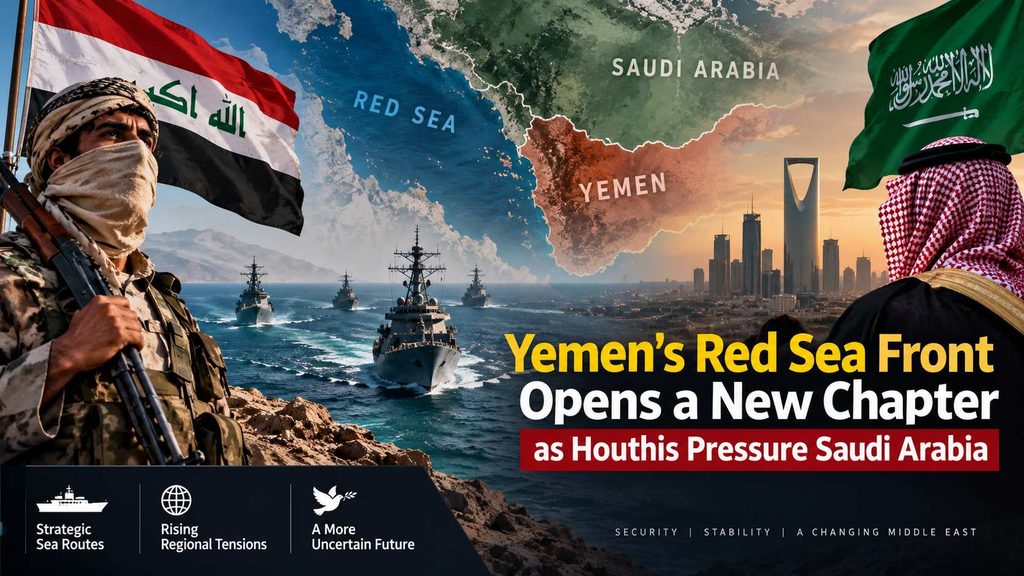
The result is a conflict that can no longer be viewed simply as another round of Yemen’s long-running civil war.
The fighting is increasingly connected to Saudi security, Red Sea shipping and the movement of global energy supplies.
Government Forces Push Back in Taiz
The latest battlefield developments are centered partly on Taiz, a province that has been one of Yemen’s most important battlegrounds for years.
Government-aligned forces reportedly advanced in western Taiz after repelling a Houthi offensive, with Saudi and Yemeni aircraft supporting operations against Houthi positions around areas including Mocha and Dhubab.
The gains are significant because Taiz connects Yemen’s interior with the Red Sea coast.
Control of this area can influence roads, supply routes and access toward the Bab el-Mandeb region.
But the battlefield remains fluid.
A separate assessment by the Institute for the Study of War said Houthi forces have continued operating in parts of Taiz and have sought to use mountainous terrain to maneuver around government-aligned positions.
So the latest government advance should not be interpreted as a decisive turning point.
The Houthis Are Looking Toward the Sea
While fighting continues inland, the Houthis have also been consolidating positions along Yemen’s Red Sea coastline.
Their recent advances have included the capture of the coastal city of Mocha and movement toward strategically important islands near the Bab el-Mandeb Strait.
Reuters reported earlier that Houthi forces had reached Perim, also known as Mayun, an island sitting directly in the Bab el-Mandeb. Yemeni government sources said government forces had withdrawn from the island.
The situation around individual islands has remained fluid, with conflicting reports about control and troop movements.
But the larger strategic picture is clearer: the Houthis are fighting for access to territory overlooking one of the world’s most important maritime corridors.
Why Bab el-Mandeb Matters
The Bab el-Mandeb connects the Red Sea with the Gulf of Aden and sits along the maritime route linking Europe and Asia.
Al Jazeera reported that the waterway handles roughly 12% of global trade, including significant volumes of oil and liquefied natural gas.
That makes every territorial gain around the strait more important than it might appear on a map.
If a military force can establish positions close to the waterway, it potentially gains greater ability to threaten commercial shipping, monitor maritime traffic and pressure regional governments.
For Saudi Arabia, the stakes are even higher.
The kingdom relies on Red Sea infrastructure as an alternative route for moving oil when the Strait of Hormuz is disrupted.
Saudi Arabia Comes Under Fire
As Houthi forces have expanded their positions in western Yemen, they have also claimed attacks against Saudi Arabia.
On September 14, the Houthis said they launched dozens of missiles and drones toward military targets at King Khalid Air Base near Khamis Mushait.
The group said the targets included aircraft hangars, radar systems, runways and ammunition facilities, describing the attacks as retaliation for Saudi airstrikes in Yemen.
Saudi authorities issued emergency alerts in several southern areas.
However, there was no immediate Saudi confirmation of the Houthi claims about damage to the military facilities. That distinction is important when assessing battlefield reports during an active conflict.
What is clear is that the fighting has crossed Yemen’s borders again, putting Saudi territory directly under pressure.
The Oil Connection Is Becoming Impossible to Ignore
The timing of the attacks is especially significant because Saudi energy infrastructure has already been affected.
A Houthi attack damaged Saudi Arabia’s East-West oil pipeline, according to recent reporting, and the pipeline is expected to remain largely out of service for several weeks while repairs are carried out.
That pipeline is strategically important because it allows Saudi crude to reach the Red Sea without traveling through the Strait of Hormuz.
In other words, the region now has pressure on both ends of Saudi Arabia’s alternative energy routes.
The Houthis are gaining positions close to the Red Sea.
At the same time, Saudi infrastructure that helps move oil toward the Red Sea has been damaged.
That combination has made Yemen’s battlefield developments a global energy story.
This Is Bigger Than Another Yemen Offensive
For years, Yemen’s conflict was largely viewed through the lens of a domestic power struggle between the Houthis and forces supporting the internationally recognized government.
That description is no longer enough.
The war is now connected to a much wider regional confrontation involving Iran, Saudi Arabia, the United States and other Middle Eastern powers.
The Houthis are aligned with Iran, while Saudi Arabia backs Yemen’s internationally recognized government.
The fighting therefore sits inside a much broader regional contest.
Recent Houthi advances have also occurred as tensions around the Strait of Hormuz remain high, creating an unusually complicated environment for energy and shipping markets.
A Dangerous Maritime Equation
The most important question may not be who controls a particular mountain or village.
It may be who controls the approaches to the Red Sea.
If Houthi forces retain positions along the western coast and around strategic islands, commercial vessels could face increased security risks.
That does not mean every ship will automatically be attacked or that global trade will stop.
But even the possibility of attacks can change shipping behavior.
Companies may choose longer routes, insurers may reassess risks and vessels may require additional security measures.
Those decisions can increase the cost and time required to transport goods.
The Human Cost Is Growing
While strategic maps and oil markets dominate international headlines, Yemen’s civilians are paying another price.
The renewed fighting has already displaced more than 100,000 people, according to the United Nations refugee agency. Thousands have also crossed the sea toward Djibouti.
The humanitarian response is becoming more difficult because fighting has damaged infrastructure, disrupted communications and restricted movement.
Every new territorial offensive therefore creates consequences far beyond the immediate military objective.
The Saudi Response Could Shape the Next Phase
Saudi Arabia now faces a difficult security calculation.
Its air force has been striking Houthi positions in Yemen, while the Houthis have demonstrated an ability to respond with missiles and drones against Saudi territory.
The two sides therefore risk entering another cycle of attack and retaliation.
The question is how far the escalation goes.
A prolonged Saudi campaign could put additional pressure on Houthi positions, but it could also generate further attacks on Saudi infrastructure.
For Riyadh, protecting energy facilities and alternative export routes is likely to remain a central concern.
Why the Islands Matter
The capture or occupation of small islands can appear insignificant compared with major cities.
In maritime warfare, however, geography works differently.
An island near a strategic shipping corridor can provide observation points, staging locations and access to surrounding waters.
That is why the Hanish Islands, Perim and other locations near the southern Red Sea have attracted so much attention.
Reuters previously reported that Houthi forces reached Perim, while later reports described Houthi deployment on Greater Hanish and Lesser Hanish.
Reports about exact control have varied, so the military situation should be treated as fluid.
But their strategic location is not in doubt.
Yemen’s War Is Once Again Becoming a Global Problem
The latest fighting demonstrates how quickly a local battlefield can affect the wider world.
A government offensive in Taiz can influence access to the Red Sea.
Houthi positions on islands can affect shipping calculations.
Missile attacks on Saudi Arabia can threaten oil infrastructure.
And disruptions to shipping and energy routes can eventually affect consumers far beyond the Middle East.
That is what makes the current escalation different from an ordinary front-line battle.
What Comes Next?
The immediate focus will be on whether government-aligned forces can consolidate their gains in Taiz and whether the Houthis can maintain their positions along the Red Sea coast.
Another critical question will be whether Houthi attacks against Saudi Arabia continue and whether Saudi forces expand their air campaign.
The humanitarian situation will also require urgent attention as displacement rises.
Most importantly, developments around the Bab el-Mandeb will be watched closely by shipping companies, energy traders and governments around the world.
For now, neither side appears to have achieved a decisive victory.
Instead, Yemen is becoming the center of a new strategic contest over territory, energy and access to the sea.
The battle may be taking place in Taiz and along Yemen’s Red Sea coast, but its consequences could be felt far beyond Yemen’s borders.